Mostrando entradas con la etiqueta trabajo museo. Mostrar todas las entradas

sábado, 1 de mayo de 2010

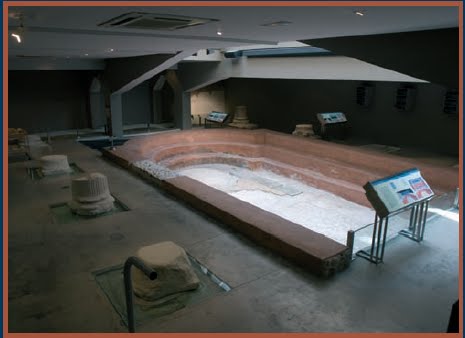
TERMAS ROMANAS

Nombre: Termas romanas.

Nombre del arquitecto: Se desconoce.

Material y técnicas: Se utilizó mármol, se adornó con mosaicos, relieves y esculturas alrededor de la sala.

Emplazamiento: Se encuentra en la calle San Juan y San Pedro, 3-7, en Zaragoza, antiguamente Caesaraugusta, entre el foro y el teatro.

Dimensiones: 9,7 m. de longitud, pero se estima que antes medía 15,8 m.

Contexto histórico del edificio: En el siglo I a.C. al IV d.C., se construyó en época de Cesaraugusto.

Transcripción: No hay ninguna.

¿Ha sido restaurado? ¿Cuándo? ¿Por qué?...: Ha sido reformado en diversas ocasiones desde que fue descubierto.

Fotografía:


Trabajo realizado por:
Estíbaliz Sánchez, Helena Peiró y Lorena Tercero.

COIN - DECADRACMA OF SIRACUSA


Name: Decadracma of Siracusa.

Name of the artist: Unknown.

Material and techniques: It´s a coin of silver, and it was made with a method of minting.

Where it was made and found: We don´t know where it was made and found.

When it was made and found: It was made in the end of V b.C. century, we don´t know when it was found.

Dimensions: Her weigh is of 43,19 grs., 37,20 mm., her axle is of 6 h.

Description:
- Obverse: A cuadriga is running to the left, above it, Nike is fliying to the right for crown to the auriga. In the exergo, a military trophy, composed of shield, greaves, cuirass and helmet, and rest of the legend AQLA.
- Reverse: Head of the nymph Aretusa with a crown of junk, earrings and a necklace of countings to the left, she is surrounding by four dolphins; behind, SU - RAK - O - SI - WN, cut by locks of hair; under of the dolphin next to the neck, the firm of the engraver of the stamp, EU - AINE. Grafila of points.

Transcription of the inscriptions:
- Obverse: AQLA.
- Reverse: SU - RAK - O - SI - WN, which means of the siracusanes.
EU - AINE, which means good fame.

Historical context: In this period the republic was installed in Rome. The Medicals wars were produced. This period was very brillant in Athens, there were greats philosophers like Pericles, Socrates or Platon.
Thematic: It´s a piece of a daily life.

Where it is to be seen now: Now it is in M.A.N.M.

Photography: The photography is obtained of the museum of Zaragoza "Reflejos de Apolo", during the exhibition.

lunes, 26 de abril de 2010

MONEDA - DECADRACMA DE SIRACUSA


Nombre: Decadracma de Siracusa.

Nombre del artista: No se sabe.

Material y técnicas: Es una moneda de plata, y fue hecha por el método de acuñación.

Dónde fue realizado y encontrado: No se sabe donde fue
realizado, ni donde fue encontrado.
Cuándo fue realizado y encontrado: Se realizó a finales del siglo V a.C., pero no se sabe cuando fue encontrado.

Dimensiones: Pesa 43,19 gramos, es de 37,20 mm, su eje es de 6 h.

Descripción:
- Anverso: Cuadriga corriendo hacia la izquierda; sobre ella, Niké volando hacia la derecha para coronar al auriga. En el exergo, un trofeo militar, compuesto por escudo, grebas, coraza y casco, y restos de la leyenda AQLA.
-Reverso: Cabeza de la ninfa Aretusa con corona de juncos, pendientes y collar de cuentas a la izquierda, rodeada por cuatro delfines; detrás, SU – RAK – O – SI – WN, cortada por los mechones del pelo; debajo del delfín situado junto al cuello, la firma del grabador del cuño, EU - AINE. Gráfila de puntos.

Transcripción de la inscripción:
-Anverso: AQLA.
-Reverso: SU – RAK – O – SI – WN, que significa de los siracusanos.
EU – AINE, que significa buena fama.

Contexto histórico de la pieza: En esta época hay instalada una república en Roma. Se produjeron las guerras médicas. Fue una época de gran esplendor para Atenas, hay grandes filósofos como Pericles, Sócrates o Platón.

Temática: Es una pieza de la vida cotidiana.

Dónde se exhibe ahora: Ahora se exhibe en M.A.N.M.

Photography: The photography is obtained of the museum of Zaragoza "Reflejos de Apolo", during the exhibition.

domingo, 18 de abril de 2010

MOSAIC OF MUSE CLIO


Name: Mosaic of muse Clio.

Name of the artist: Unknown.

Material and techniques: It´s a technique of opus tesselatum.

Where it was made and found: It was found under the street Murallas Romanas and square Cesaraugusto, in Zaragoza.

When it was made and found: It was made in the II a.C. century, it was found around XX century.

Dimensions: Height 1,76 m., width 0,81 m.

Description: It´s a figure computing in a pavement of a triclinium in a huge house, called the house of Orfeus.

Thematic: It contains mythological subjects. Among them, it is partially preserved head of a faunus. There is a circuler emblem inside a square, and it´s angles showed representations of some muses. Clio with a tunic and diadem of pens, watches at the right and it respectively flanks by a style and wax small boards to write (diptychon), these symbols are normally associated with the muse Clio. The topic of muses can be interpreted as a reference to the arts in generic sense and the presence of Orfeus in another room of this domus, would reinforce this idea.

Where it is to be seen now: Now it can see in the Museum of Zaragoza.

viernes, 16 de abril de 2010

CUP WITH THESEUS AND THE BULL


Name: Cup with Theseus and the bull.

Name of the artist: Oltos painter.

Material and techniques: Pottery. Techniques of red figures. This decorative technique started around 530 b.C. and it replaced the technique of black figures. The scenes were drawn in red or were engraved upon fresh clay, over black background. This technique lasted until the III century.


Where it was made and found: It was made in Atica, we don´t know where it was found.

When it was made and found: It was made around 510 b.C., it´s unknown when it was found.

Dimensions: Height 14 cm, width 32 cm.

Thematic: Theseus, a civillising hero and an example of the Athenian ephebes, appears running behind a bull, as a nacked adolescent, wearing a myrtle wreath. Theseus, the mythical king of Athens, avercame the monster and offered it up as a sacrifice on the Acropolis of Athens. Theseus won to the bull in the labyrinth thanks to the thread ball of yarn that Adriadna had given to him, who was in love with him. This history is told in the seventh work of Hercules.

Where it is to be seen now: Now it is located in M.A.N.M.

martes, 6 de abril de 2010

STATUE OF DEMETER-CERES


Name: Statue of Demeter-Ceres.

Name of the artist: Unknown.

Material and techniques: It is carved in marble and gray limestone.

Where it was made and found: Is unknown where it was made, it was found in a Roman ville in La Malena, Azuara, in Zaragoza.

When it was made and found: It was made in the IV century a.C., more exactly in the third quarter of IV century a.C., it is unknown when it was found.

Dimensions: The height of the statue is 58 cm.

Description: It´s a headless statue, the head was decorated with a "spicea" crown, wears a tunic and "dorsal himation" hanging on the back. In the right hand it holds a "patera" with cocoon in flower in an offering attitude, and in the left hand it holds a knotted torch, so it is called "dea taedifera". Its feet are showed slightly below the dress. Demeter received a cult that people celebrated in the town of the Malena, a rural villa of controversial interpretation. The statue has spots of oxidation from the inner irons that served as a support for some parts of the statue.
Thematic: Demeter - Ceres was in classic mythology the goddess of agriculture, the cereals and the harvest. Goddess of the life in the field, she was identified with the Earth fertility, since she fertilized the fields and the scallop shell like the "carried of the stations". She represents the fecundity.

Historical context: The emperor Constantine ends the persecution of Christians in the Roman Empire. Rome decreased its importance due to its location for away from important provinces like Gallic, Hispania... The general prosperity fell in this period but problems arose from security in the empire by the invasions that are repeated forwards from 376 by the germanic tribes. These invasions marked the beginning of the fall of the western Roman Empire. In 378 the battle arose from Adrianopolis.

Where it is to be seen now: Now it is exhibited in the museum of Zaragoza.

Photography: It was made for me in the museum of Zaragoza.

lunes, 5 de abril de 2010

MOSAICO DE LA MUSA CLÍO


Nombre: Mosaico de la musa Clío.

Nombre del artista: Desconocido.

Material y técnicas: Se trata de un mosaico teselado.

Dónde fue realizado y encontrado: Bajo la calle Murallas romanas y Plaza de Cesaraugusto, Zaragoza.

Cuándo fue realizado y encontrado: Fue realizado en el siglo II d.C., se encontró alrededor del siglo XX.

Dimensiones: 1,76 x 0,81 m.

Descripción: Es una figura integrada en un pavimento de triclinio de una casa de enormes dimensiones, la casa de Orfeo.

Temática: Contiene asuntos mitológicos. Entre ellos, la conservada parcialmente cabeza de fauno. El emblema circular se inscribe en un cuadrado, cuyos ángulos inscribieron representaciones de musas. Clío con túnica y diadema de plumas, mira a la derecha y se flanquea respectivamente por un estilo y unas tablillas de cera para escribir (diptychon), los símbolos con los que se asocia normalmente en época avanzada la musa Clío. Los temas de las musas pueden interpretarse como alusiones a las artes en sentido genérico y la presencia de Orfeo en otra estancia de esta mansión , reforzaría esta idea.

Donde se exhibe ahora: Se puede ver en el Museo de Zaragoza.
Fotografía:

COPA CON TESEO Y EL TORO

Nombre: Copa con Teseo y el toro.

Nombre del artista: Pintor Oltos.

Material y técnicas: Cerámica. Técnica de figuras rojas. Cerámica de figuras rojas técnica de decoración iniciada hacia el año 530 a.C. y que sustituye a la técnica de figuras negras. Las escenas se dibujaban en rojo o se grababan sobre la arcilla fresca, sobre fondo en negro. Esta técnica comenzó a desaparecer en el s. III.

Dónde fue realizado y encontrado: Fue realizado en Ática, no se sabe donde fue encontrado.

Cuándo fue realizado y encontrado: Fue realizado alrededor del año 510 a. C., se desconoce cuando fue encontrada.

Dimensiones: Altura 14 cm., anchura 32 cm.

Temática: Teseo, héroe civilizador y ejemplo de los efebos atenienses, corriendo detrás de un toro, como adolescente desnudo, llevando una corona de mirto. Teseo, mítico rey de Atenas sometió al monstruo y lo ofreció en sacrificio sobre la Acrópolis ateniense. Teseo venció al toro en el laberinto gracias al ovillo de hilo que le había entregado Adriadna, su enamorada. La historia se recoge en el séptimo trabajo de Hércules.

Dónde se exhibe ahora: Ahora está localizado en M.A.N.M.

Fotografía obtenida de: http://lh6.ggpht.com/_iZ6CR08LX_w/R1h4njtX0UI/AAAAAAAAAV0/7yx4THEfTVI/Copa+con+Teseo+y+el+toro.%C3%81tica,+pintor+Oltos+510.jpg

domingo, 24 de enero de 2010

ESTATUA DE DEMÉTER - CERES


Nombre: Estatua de Deméter-Ceres.

Nombre del artista: Desconocido.

Material y técnicas: Está esculpida en mármol veteado y en caliza gris.

Dónde fue realizado y encontrado: No se sabe dónde fue realizada, se encontró en la villa de la Malena, en Azuara, Zaragoza, en la estancia central.

Cuándo fue realizado y encontrado: Fue realizada entorno al siglo IV d.C., más exactamente al tercer cuarto del siglo IV d.C., no se sabe cuando fue encontrada.

Dimensiones: Tiene una altura de unos 58 centímetros aproximadamente.

Descripción: Se trata de una estatua acéfala, la cabeza estuvo adornada con una corona “spicea”, lleva una túnica e “himation dorsal”, colgando sobre la espalda. En la mano derecha lleva pátera con capullo en flor en actitud oferente, y en la mano izquierda sujeta una antorcha nudosa, llamada “dea taedifera”. Sus pies asoman levemente por debajo del vestido. Deméter recibió culto en la villa de la Malena, asentamiento rural de interpretación controvertida. Se notan las manchas de oxidación de los hierros interiores que sirvieron de sujeción para algunas partes de la estatua.

Temática: Deméter-Ceres era en la mitología clásica la diosa de la agricultura, los cereales y las cosechas. Diosa de la vida en el campo, era identificada con la fertilidad de la Tierra, ya que fecundaba los campos y se la venera como la «portadora de las estaciones». Representa la fecundidad.

Contexto histórico: El emperador Constantino pone fin a la persecución de cristianos en el Imperio Romano. Roma disminuye en la importancia debido a su localización lejos de puntos potenciales, como Europa central y el este. La prosperidad general se siente en este período, pero surgen problemas de seguridad en el imperio por las invasiones que se repiten desde 376 hacia adelante por las tribus germánicas. Estas invasiones marcan el principio de la caída del imperio romano occidental. En 378 surge la batalla de Adrianópolis.

Dónde se exhibe ahora: Ahora se exhibe en el museo de Zaragoza.

Fotografía:
Hecha por mí en el museo de Zaragoza.